
Architectural Flowchart of Modern ERP Infrastructure 2026
To understand how enterprise technology operates today, it is essential to map the continuous flow of data across interconnected operational nodes. Modern enterprise software design has abandoned monolithic, closed databases in favor of an open, event-driven ecosystem.
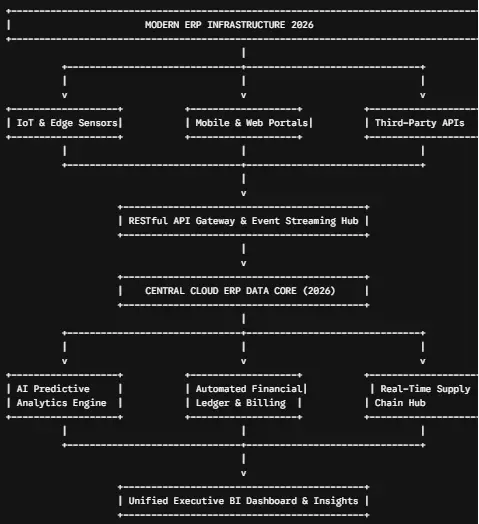
As illustrated in the flowchart above, data collection begins at operational endpoints such as Internet of Things (IoT) edge sensors, customer portals, and external API gateways. These data streams enter a centralized API gateway that routes real-time telemetry into the cloud core. From there, machine learning algorithms, automated financial ledgers, and supply chain modules process the incoming data simultaneously, feeding live intelligence into executive business intelligence dashboards.
Defining the Ecosystem of Modern ERP Infrastructure 2026
The corporate landscape of 2026 demands unprecedented operational speed, resilience, and adaptability. Legacy enterprise software that relies on rigid, on-premises server stacks can no longer keep pace with global supply chain disruptions, fluctuating consumer behaviors, and rapid regulatory updates. In response, market leaders have shifted toward Modern ERP Infrastructure 2026, an architectural paradigm built upon cloud-native elasticity, artificial intelligence, and autonomous workflow capabilities.
Unlike early-generation cloud migrations that merely shifted legacy code onto virtual machines, modern architecture embraces composability. Enterprises build custom operational stacks by connecting specialized microservices through standardized Application Programming Interfaces (APIs). This granular approach allows business units to adopt best-of-breed modules for demand forecasting, human capital management, or automated financial auditing without disrupting the core database architecture.
Furthermore, enterprise software in 2026 operates natively in multi-cloud and hybrid-cloud environments. By distributing workload processing across leading cloud infrastructure providers, organizations achieve near-zero downtime, satisfy strict data residency requirements, and optimize server processing costs based on real-time computational loads.
Key Pillars Defining Modern ERP Architecture in 2026
Understanding the foundational components of modern enterprise software helps organizations evaluate their technology readiness and structure their digital transformation investments effectively.
1. Embedded Artificial Intelligence and Machine Learning Core
Artificial intelligence is no longer an optional add-on module; it is embedded directly into the central database kernel of enterprise software. Predictive algorithms continuously analyze transaction patterns, historical purchasing behavior, and market indicators to generate automated forecasts. In financial operations, AI engines identify anomalous transactions in real time, preventing fraudulent payments and accelerating month-end close schedules automatically.
2. Microservices and Event-Driven Cloud Design
Traditional enterprise platforms relied on monolithic software designs where updating a single feature required testing the entire codebase. Modern infrastructure utilizes microservices architecture, breaking applications into independent functional components. When developers update the inventory forecasting module, other system applications continue operating without interruption, ensuring uninterrupted business continuity.
3. Hyper-Automation via Robotic Process Automation (RPA)
Operational efficiency relies heavily on eliminating repetitive manual tasks. Integrated software environments deploy robotic process automation bots to handle routine data entry, order verification, vendor invoice matching, and employee onboarding documentation. This level of hyper-automation reduces operational overhead and allows personnel to focus on higher-level strategy.
4. Zero-Trust Cybersecurity and Data Encryption Frameworks
With distributed workforces and cloud-hosted operational nodes, perimeter-based network security is no longer sufficient. Enterprise systems in 2026 enforce strict zero-trust security frameworks. Every user request, automated API call, and data transfer undergoes continuous identity verification, granular access control checks, and end-to-end encryption both at rest and in transit.
Key Operational Advantages of Upgrading to Modern Infrastructure
Adopting advanced enterprise architecture provides quantifiable operational and financial benefits that directly support long-term corporate growth.
Unprecedented Agility and Scalability
As companies expand into new international regions, acquire subsidiaries, or introduce direct-to-consumer sales channels, legacy systems create execution bottlenecks. Cloud-native architectures allow IT teams to provision new operational modules, localized tax structures, and multi-currency databases in hours rather than months.
Real-Time Financial Visibility and Precision
Relying on outdated weekly or monthly batch reporting limits executive decision-making. Modern cloud environments process financial transactions instantaneously, delivering live income statements, cash flow projections, and operational expense metrics to executive dashboards. This visibility enables financial leaders to allocate capital strategically and respond swiftly to market volatility.
Lower Total Cost of Ownership Through Predictable OpEx
Maintaining aging physical servers requires continuous capital expenditure for hardware refreshes, facility cooling, dedicated data center maintenance, and specialized IT support staff. Shifting to cloud-hosted software converts unpredictable capital expenses into a streamlined, subscription-based operational expenditure model that scales dynamically with business usage.
Comparing Legacy On-Premises Architecture with Modern Cloud ERP Infrastructure 2026
Evaluating the evolution of enterprise software demonstrates why legacy platforms are rapidly becoming obsolete across modern industrial sectors.
In legacy environments, software installation was restricted to physical server hardware housed within on-premises server rooms. Upgrades were executed infrequently—often every five to seven years—because custom code modifications made system updates expensive and disruptive to business operations. Data processing occurred in static batches, restricting reporting capabilities to periodic offline spreadsheets.
Conversely, Modern ERP Infrastructure 2026 operates entirely within distributed cloud environments supported by multi-tenant or dedicated cloud instances. Software providers deliver continuous, automated updates every quarter without interrupting daily business operations or breaking custom API integrations. Data processing occurs in real time across event-driven streaming hubs, powering instant business intelligence dashboards and mobile access points for remote workforces globally.
Strategic Roadmap for Implementing Modern ERP Infrastructure
Transitioning from legacy tech stacks to modern enterprise platforms requires careful planning, disciplined execution, and active change management across all business functions.
Step 1: Enterprise Architecture Audit and Process Mapping
Begin by auditing existing software dependencies, database structures, and operational workflows across every department. Identify functional bottlenecks, unsupported legacy custom code, and data duplication patterns to establish a clean baseline for the target cloud architecture.
Step 2: Defining Strategic Goals and Composable Requirements
Determine the specific business outcomes driving the modernization initiative. Establish measurable performance metrics, such as reducing order processing times, improving inventory forecasting accuracy, or automating invoice reconciliation. Select modular cloud software applications that match your industry requirements.
Step 3: Data Hygiene, Standardisation, and Cloud Migration
Data quality determines the success of enterprise software projects. Legacy databases often contain obsolete, incomplete, or duplicate records. Implement strict data governance policies to clean, standardize, and validate all master data before executing database migration scripts into the target cloud environment.
Step 4: System Integration, API Mapping, and Security Configuration
Configure RESTful API gateways, event streaming pipelines, and identity management frameworks. Ensure third-party applications—such as customer relationship management software, e-commerce storefronts, and banking gateways—integrate smoothly with the core cloud database under zero-trust security protocols.
Step 5: End-to-End Simulation, Testing, and User Acceptance
Conduct comprehensive testing cycles, including unit testing, API performance benchmarks, security vulnerability assessments, and full user acceptance testing (UAT). Simulate peak transactional volumes to confirm system stability before scheduling the formal cutover window.
Step 6: Phased Deployment, User Empowerment, and Optimization
Execute the migration strategy using a phased departmental rollout or regional go-live plan to minimize operational exposure. Provide tailored, role-based training programs to ensure smooth user adoption, and monitor performance metrics closely to optimize system workflows post-launch.
Navigating Implementation Challenges and Risk Mitigation
While the advantages of modernizing enterprise software are substantial, business leaders must manage common execution risks proactively.
Managing Scope Creep and Project Creep
Enterprise transformation initiatives can easily exceed budgets if departments continually request non-essential custom features during implementation. Mitigate scope creep by establishing a strict project steering committee and enforcing standard, out-of-the-box software capabilities wherever possible.
Mitigating Organizational Change Resistance
Employees accustomed to legacy software interfaces often resist adapting to new automated workflows. Address change management early by involving department power users in system configuration, communicating strategic benefits clearly, and providing ongoing hands-on training sessions.
Ensuring Data Privacy and Regulatory Compliance
Operating global cloud software requires strict compliance with regional data privacy laws, such as GDPR in Europe or state-level privacy mandates in North America. Choose cloud providers that offer localized data hosting capabilities and automated compliance monitoring tools within their core software architecture.
Conclusion: Securing Competitive Dominance in 2026 and Beyond
Upgrading to Modern ERP Infrastructure 2026 is no longer merely an IT infrastructure project; it is a fundamental business imperative. Organizations that continue running mission-critical operations on aging, siloed software face escalating maintenance costs, operational inertia, and severe cyber vulnerabilities.
By adopting flexible cloud architecture, embedding real-time artificial intelligence, and establishing robust API integrations, forward-thinking enterprises establish a resilient operational foundation. This digital core enables companies to innovate continuously, execute with speed, and outpace competitors in an increasingly dynamic global marketplace.