
The Evolutionary Flow of Modern ERP Technology 2026
In today’s hyper-connected business environment, organizational agility depends on digital infrastructure. Legacy software architectures can no longer support dynamic operational speeds. As enterprise demands expand across global supply chains and remote workforces, Modern ERP Technology 2026 establishes the standard for real-time enterprise management.
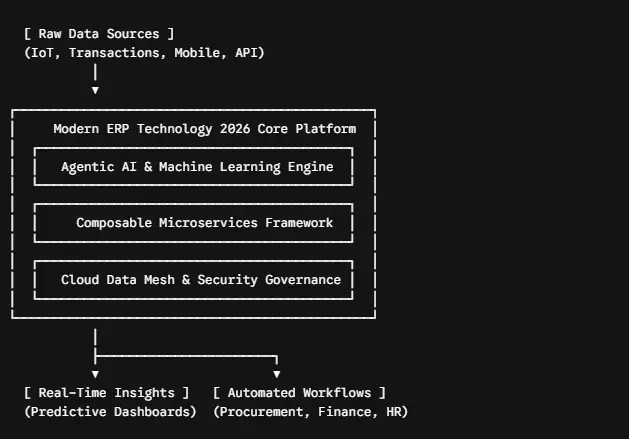
The flowchart above illustrates the end-to-end data processing workflow within Modern ERP Technology 2026. Raw data ingested from Internet of Things (IoT) sensors, transactional touchpoints, mobile apps, and third-party cloud applications streams directly into the central processing core. Inside the platform, autonomous intelligence layers work alongside microservices frameworks to process incoming datasets in real time. This unified workflow generates predictive analytical insights while automatically triggering cross-departmental operations—from inventory reordering to financial reconciliation—without manual intervention.
Defining the Core Architecture of Modern ERP Systems in 2026
To understand how Modern ERP Technology 2026 differs from legacy platforms, it is essential to examine its fundamental structural architecture. The enterprise technology market has moved completely away from rigid, monolithic systems that require expensive manual customizations.
Composable and Modular Design
Modern platforms rely on a composable architecture where individual business capabilities function as independent microservices. Instead of deploying a single, unwieldy application, enterprises build customized software stacks using modular components that connect seamlessly via RESTful Application Programming Interfaces (APIs). This modular design allows companies to add, update, or replace specific modules—such as inventory tracking or procurement—without disrupting core financial ledgers.
Native Cloud Execution and Data Mesh Architectures
Multi-tenant cloud infrastructure serves as the baseline deployment model. Rather than maintaining physical server rooms, organizations leverage elastic cloud environments provided by hyperscale infrastructure platforms. By utilizing a data mesh strategy, decentralized business units maintain ownership of their operational data while sharing standardized metrics across the central enterprise engine in real time.
Low-Code and No-Code Application Development
Customizing enterprise software traditionally required specialized software engineers and months of development effort. Modern platforms empower non-technical business leaders and department managers to configure custom workflows, user interfaces, and automated notification triggers using drag-and-drop low-code frameworks. This democratization of application development drastically accelerates operational innovation.
The Pivotal Role of Agentic AI and Hyperautomation
Artificial intelligence has evolved beyond basic chatbot assistants and static reporting tools. The defining characteristic of Modern ERP Technology 2026 is the integration of autonomous AI agents embedded directly into operational workflows.
Autonomous Operational Decision-Making
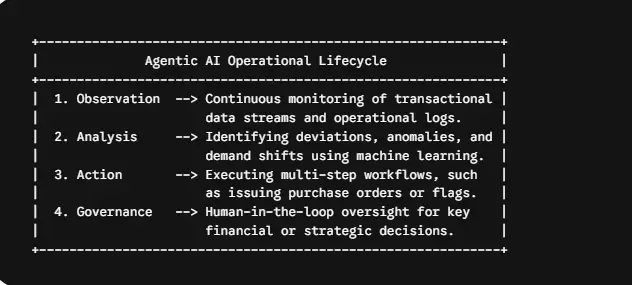
Agentic AI agents do not simply present charts; they execute complex, multi-step business routines independently. For example, when an AI agent detects a demand spike for a manufactured component alongside supplier delays, it automatically evaluates alternative vendors, verifies pricing parameters, checks inventory thresholds, and drafts purchase orders for human review.
Predictive Analytics and Financial Forecasting
Traditional software produces historical reporting, telling executives what happened last week or last month. Modern platforms utilize predictive algorithms to model future outcomes. Financial teams leverage live transactional data to generate dynamic cash flow forecasts, automatically highlight budget variances, and simulate complex market scenarios in real time.
Hyperautomation Across Core Departmental Workflows
By combining robotic process automation (RPA), machine learning, and rule engines into a single orchestration layer, hyperautomation eliminates repetitive administrative tasks. Accounts payable reconciliation, customer onboarding documentation, payroll calculations, and vendor invoice matching operate continuously with minimal human error.
Key Business Advantages of Adopting Modern Cloud Architectures
Transitioning from outdated legacy software to modern cloud infrastructure provides strategic and financial returns for enterprise organizations.
Unrivaled Real-Time Operational Visibility
Consolidating operational datasets into a single cloud ecosystem gives executive leadership complete visibility across global operations. Real-time dashboards provide immediate clarity regarding inventory positions, manufacturing bottlenecks, financial performance, and customer delivery timelines, enabling data-driven decision-making.
Continuous Software Updates Without Operational Downtime
Legacy software updates were notoriously expensive, disruptive, and infrequent, often occurring years apart due to fragile custom code dependencies. Modern cloud systems deliver continuous, automated updates directly from software vendors. Organizations access cutting-edge security features, functional enhancements, and AI algorithms without system downtime.
Enterprise Security, Governance, and Regulatory Compliance
Cybersecurity risks grow more sophisticated every year. Modern enterprise software incorporates zero-trust architecture, multi-factor authentication, end-to-end data encryption, and automated audit trails. Furthermore, built-in compliance frameworks simplify adherence to international regulatory requirements, including GDPR, ESG metrics reporting, and local tax legislation.
Strategic Implementation Roadmap for Cloud ERP Transformation
Upgrading enterprise software requires careful project planning, cross-functional collaboration, and disciplined change management. Following a structured roadmap ensures project success and minimizes operational disruption.
Step 1: Aligning Strategic Vision and Core Requirements
Before reviewing software vendors, define clear business outcomes. Establish quantifiable key performance indicators, such as reducing month-end financial closing cycles, improving inventory turnover rates, or automating supply chain visibility. Form a steering committee with executive representation from finance, operations, IT, and sales.
Step 2: Evaluating Cloud Platforms and Ecosystem Partners
Select software solutions that align with your specific vertical industry requirements. Assess platform capabilities based on cloud security certifications, API integration flexibility, agentic AI maturity, and vendor product roadmaps. Partner with certified system integrators who possess proven domain expertise.
Step 3: Executing Data Governance and Data Cleansing
Data quality determines software performance. Prior to migrating records into the target environment, audit existing databases thoroughly. Remove duplicate customer files, resolve unstandardized nomenclature, and validate historical records to ensure only accurate, high-quality data enters the modern system architecture.
Step 4: Iterative Configuration, API Integration, and Rigorous Testing
Configure composable software modules according to predefined business rules. Build and verify secure API connections between the core platform, third-party customer portals, banking interfaces, and supply chain networks. Conduct multi-stage testing, including integration tests, security audits, and User Acceptance Testing (UAT).
Step 5: Change Management, Workforce Upskilling, and Go-Live
System adoption relies heavily on user readiness. Conduct role-based training programs that educate employees on navigating intuitive modern interfaces and collaborating with embedded AI agents. Execute a phased go-live deployment, providing dedicated technical support to address user inquiries immediately after launch.
Navigating Modern Enterprise Software Transformation Risks
While the benefits of modernizing software infrastructure are undeniable, managing transition risks requires proactive leadership strategies.
Managing Scope Creep and Project Budgets
Customization requests can quickly inflate implementation timelines and project expenses. Maintain strict project governance by prioritizing out-of-the-box composable features over complex custom coding. Address unique business requirements using low-code tools rather than modifying underlying core software.
Balancing Artificial Intelligence Autonomy with Human Oversight
Deploying agentic AI agents requires clear operational guardrails. While autonomous agents execute routine operational workflows effectively, high-value financial commitments, strategic vendor contracts, and sensitive workforce management tasks must retain human-in-the-loop oversight to ensure accountability and strategic alignment.
Addressing Workforce Cultural Resistance
Employees used to legacy interfaces may show initial resistance to automated workflows. Overcome cultural friction through transparent leadership communication, emphasizing how automated systems remove tedious manual tasks and empower personnel to focus on higher-value strategic initiatives.
Conclusion: Driving Sustained Competitive Advantage in 2026
Adopting Modern ERP Technology 2026 is no longer a simple back-office IT decision; it is a vital strategy for enterprise growth and resilience. By unifying composable cloud architectures, real-time analytics frameworks, and autonomous agentic AI capabilities into a central operational core, modern enterprises eliminate structural friction and prepare their operations for long-term innovation.
Organizations that embrace modern cloud infrastructure position themselves to navigate market shifts, optimize complex supply chains, and unlock sustainable competitive advantages in an increasingly automated global economy.