
Understanding the Core Framework of ERP Modules
Modern organizations rely on enterprise software ecosystems to coordinate complex departmental operations, automate critical workflows, and unify business data. Rather than operating as a single rigid program, enterprise resource planning software functions as an interconnected suite of functional building blocks known as modules. Understanding a clear comparison of ERP modules explained allows business leaders and IT architects to design a platform tailored to their specific operational scale and industry needs.
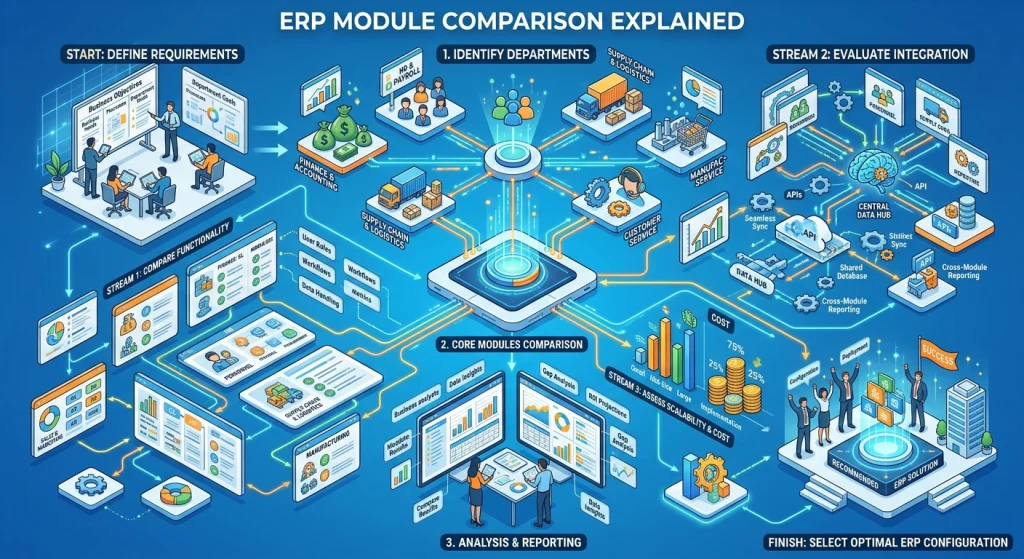
The modular design of enterprise platforms offers incredible operational flexibility. Companies can initially deploy core modules—such as general accounting and inventory management—and progressively integrate advanced applications as their business expands. Because every module connects directly to a shared core database, data entered in one department instantly propagates across the entire system. This automated synchronization eliminates manual data re-entry, reduces human error, and provides executive leadership with a single source of truth across all business units.
Detailed Comparison of ERP Modules Explained Across Business Operations
To make informed architectural decisions, business leaders must evaluate how different enterprise modules function, what specific operational challenges they address, and how they interact within the central database ecosystem.
1. Financial Management Module vs. Supply Chain Management Module
The financial management module serves as the structural foundation for almost every enterprise software deployment. It manages general ledger accounting, accounts payable, accounts receivable, fixed asset tracking, budgeting, and tax compliance. Its primary objective is maintaining regulatory compliance and providing real-time visibility into financial health.
In contrast, the supply chain management module focuses on physical inventory movement and logistics. It oversees procurement processes, warehouse storage, demand forecasting, stock replenishment, and vendor relations. While the finance module tracks monetary value and transaction records, the supply chain module tracks physical goods and operational movement.
The two modules work in constant alignment. When the supply chain module records an incoming purchase order at a warehouse, it automatically triggers an update in the finance module to log an account payable and increase total asset valuation.
2. Human Capital Management (HCM) Module vs. Customer Relationship Management (CRM) Module
The Human Capital Management module centers on internal workforce operations. It automates payroll calculations, employee onboarding, performance management, time tracking, benefits administration, and organizational hierarchy planning. Its main goal is optimizing internal talent management and maintaining compliance with labor laws.
On the other hand, the Customer Relationship Management module manages external customer interactions. It tracks sales pipelines, customer communication history, marketing campaigns, service tickets, and contract renewals. While HCM focuses on internal workforce efficiency, CRM drives external revenue generation and customer satisfaction.
Integration between HCM and CRM is critical for project-based and service-driven industries. For example, when a sales representative closes a project contract in the CRM, the system can instantly alert the HCM module to evaluate internal staff availability and assign qualified team members.
3. Manufacturing Module vs. Inventory and Warehouse Management Module
The manufacturing and production planning module is engineered specifically for industrial and production environments. It controls complex bills of materials, shop floor execution schedules, work-order routing, machine capacity planning, and quality control metrics.
While the inventory and warehouse management module focuses on stock storage locations, picking, packing, shipping, and raw material tracking, the manufacturing module governs the transformation of those raw materials into finished products.
These two applications rely on continuous real-time communication. The manufacturing module requests raw components from the warehouse module based on production schedules, and once manufacturing is complete, it transfers finished inventory back to the warehouse system for distribution.
Evaluating Deployment Models: Cloud vs. On-Premises ERP Modules
Choosing the right deployment architecture for enterprise software modules is just as crucial as selecting the modules themselves. The choice between cloud-native and on-premises environments impacts initial capital investment, upgrade flexibility, and system accessibility.
On-premises module deployments require physical server hardware hosted locally within company data centers. This model provides maximum direct control over database physical security and system code customizations. However, it requires heavy upfront capital investment, dedicated IT maintenance staff, and manual upgrade processes that can disrupt ongoing business workflows.
Cloud-native enterprise modules operate on a subscription model hosted on secure cloud infrastructure provided by major cloud vendors. Cloud modules eliminate physical hardware maintenance, lower initial capital expenditure, and offer continuous, automatic quarterly feature updates. Additionally, cloud setups enable secure remote access across global locations and mobile devices, empowering hybrid teams to collaborate effortlessly.
Critical Factors for Selecting and Prioritizing ERP Modules
Selecting the optimal combination of software modules requires evaluating organizational priorities, industry requirements, and long-term growth objectives.
Assessing Industry-Specific Operational Requirements
Different industry verticals require distinct module configurations. A manufacturing firm must prioritize production planning, bill of materials, and inventory modules. Conversely, a digital marketing agency or consulting firm will gain higher immediate ROI by prioritizing financial management, project accounting, and CRM applications.
Evaluating Integration Flexibility and API Openness
Before committing to specific enterprise software modules, evaluate their ability to integrate with third-party software applications. High-performing platforms offer robust RESTful APIs and pre-built connectors that allow specialized tools—such as e-commerce platforms, payment gateways, or custom analytics dashboards—to exchange data seamlessly with core enterprise modules.
Budget Considerations and Total Cost of Ownership
Deploying every available software module simultaneously can lead to excessive implementation costs, extended project timelines, and organizational burn-out. Organizations should calculate the total cost of ownership—including licensing, implementation consulting, data migration, and training—and adopt a phased implementation roadmap prioritizing high-impact core modules first.
Best Practices for a Successful Modular ERP Implementation
A successful enterprise software rollout depends on clear governance, disciplined data hygiene, and structured change management across all involved departments.
Step 1: Establish Cross-Functional Project Leadership
Form a dedicated project steering committee consisting of department heads, IT leaders, executive sponsors, and external implementation partners. Defining clear project milestones and functional requirements early prevents scope creep and ensures departmental alignment.
Step 2: Standardize and Clean Master Data Before Migration
Data hygiene represents one of the biggest failure points in software implementations. Legacy databases often hold duplicate, outdated, or inconsistent customer and inventory records. Cleanse, validate, and standardize master data before migrating it into new enterprise modules to prevent post-launch operational errors.
Step 3: Invest in Tailored, Role-Based Change Management
System adoption dictates long-term return on investment. Employees accustomed to legacy interfaces often resist adopting updated modular workflows. Develop role-based training programs, document standard operating procedures clearly, and designate internal change champions in each department to guide peers through the transition.
Step 4: Conduct Rigorous Multi-Stage System Testing
Execute multi-stage testing phases—including unit testing, cross-module integration testing, and comprehensive User Acceptance Testing (UAT)—to verify data flow accuracy and resolve system bottlenecks before decommissioning legacy platforms.
Conclusion: Building a Scalable Digital Foundation
Navigating a comprehensive comparison of ERP modules explained highlights that modern enterprise success relies on choosing the right combination of interconnected software applications. By centralizing core financial, operational, human capital, and customer workflows into a unified cloud database, enterprises eliminate data silos, strengthen regulatory compliance, and position themselves for long-term operational excellence.
Whether modernizing legacy architecture or deploying enterprise software for the first time, selecting scalable, high-performing modules establishes a resilient digital foundation capable of adapting to evolving market demands.