
In today’s fast-paced digital economy, organizations face immense pressure to operate with maximum efficiency, agility, and transparency. As businesses grow, managing disparate software tools for finance, human resources, inventory, and customer service becomes a recipe for operational chaos. Enter the Enterprise Resource Planning (ERP) system—the digital nervous system of modern business.
Whether you are a scaling mid-market enterprise looking to upgrade your legacy infrastructure or a global corporation evaluating next-generation cloud platforms, understanding the true scope of an enterprise ERP system is critical. This comprehensive guide explores what enterprise ERP systems are, their core modules, key benefits, deployment models, and a proven roadmap for successful implementation.
1. What is an Enterprise ERP System?
An Enterprise ERP System is an integrated software platform that organizations use to manage their core business processes in real-time. By centralizing data from various departments—such as finance, supply chain, manufacturing, sales, procurement, and human resources—an ERP system breaks down traditional data silos.
Enterprise ERP systems provide centralized dashboards that offer a single source of truth across all organizational departments.
Historically, departments operated in isolation, using separate spreadsheets or standalone legacy software. This fragmentation led to redundant data entry, delayed reporting, and misaligned decision-making. An enterprise ERP replaces these disconnected tools with a unified database and a single source of truth, enabling seamless cross-functional collaboration.
2. Core Modules of Modern Enterprise ERP Solutions
A comprehensive enterprise ERP system is built on a modular architecture, allowing businesses to implement the specific capabilities they need while maintaining a unified core. Key modules typically include:
- Financial Management: The backbone of any ERP, handling general ledger, accounts payable/receivable, asset management, risk management, and financial reporting.
- Supply Chain Management (SCM): Optimizes the flow of goods, managing inventory levels, warehouse operations, order fulfillment, and logistics tracking.
- Human Resources & Payroll (HCM): Manages employee lifecycles, recruitment, onboarding, performance management, benefits administration, and global payroll processing.
- Customer Relationship Management (CRM): Tracks customer interactions, sales pipelines, marketing automation, and post-sales support to drive retention.
- Manufacturing Execution System (MES): Coordinates shop floor operations, production scheduling, bill of materials (BOM), and quality control.
- Procurement: Streamlines vendor management, purchase requisition, purchase orders, and supplier contract compliance.
3. The Transformative Benefits of Enterprise ERP Systems
Investing in an enterprise-grade ERP requires significant capital and resource commitment, but the long-term return on investment (ROI) is substantial.
Enhanced Data Accuracy and Visibility
With all business data consolidated into a single database, executives and managers no longer have to wait weeks for end-of-month reports. Real-time analytics and customizable dashboards offer immediate visibility into key performance indicators (KPIs), empowering faster and more accurate decision-making.
Process Automation and Efficiency
Manual data entry and routine administrative tasks are prone to human error and consume valuable employee hours. ERP systems automate workflows—such as automatically triggering purchase orders when inventory dips below a certain threshold or updating general ledgers upon invoice approval—freeing staff to focus on high-value strategic initiatives.
Cross-functional collaboration is vastly improved when teams share standardized, real-time data platforms.
Regulatory Compliance and Security
Modern enterprises operate in complex regulatory environments characterized by stringent data privacy laws (such as GDPR) and financial reporting standards (like SOX or IFRS). Enterprise ERP systems incorporate robust security protocols, role-based access controls, and audit trails to protect sensitive corporate data and ensure compliance.
Scalability for Growth
As businesses expand into new geographic markets, acquire competitors, or launch new product lines, their software infrastructure must keep pace. Enterprise ERP systems are designed to scale effortlessly, supporting multi-entity structures, multi-currency transactions, and multi-language requirements without missing a beat.
4. Cloud vs. On-Premise ERP: Choosing the Right Deployment Model
When selecting an enterprise ERP, one of the most critical decisions is choosing between cloud-based (SaaS) and on-premise deployment models.
On-Premise ERP
- Control: The organization owns and maintains the physical servers and hardware infrastructure.
- Customization: Offers deep, highly tailored customization of source code to fit unique legacy workflows.
- Drawbacks: High upfront capital expenditure (CapEx), resource-intensive maintenance, slower upgrade cycles, and reliance on internal IT teams for security.
Cloud-Based ERP (SaaS)
- Agility & Accessibility: Hosted on secure vendor servers and accessible via any web browser, enabling remote collaboration and fast deployment.
- Cost Structure: Operates on an operational expenditure (OpEx) subscription model, significantly lowering upfront costs.
- Automatic Updates: Vendors handle security patches, software updates, and infrastructure scaling automatically.
- Drawbacks: Less control over exact maintenance windows and potential concerns regarding strict industry data residency requirements (though largely mitigated by top-tier cloud providers).
5. A Step-by-Step Implementation Strategy for Enterprise ERP
Implementing an ERP system is not merely an IT project; it is a profound organizational transformation. Success requires careful planning and disciplined execution.
Key Rule of Implementation: Change management is just as important as technical configuration. User adoption can make or break an ERP project.
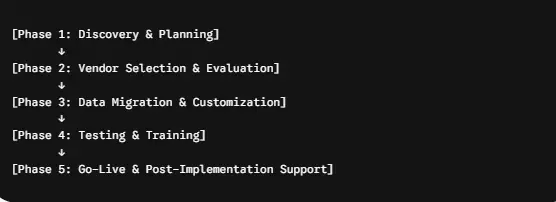
Step 1: Discovery and Requirements Gathering
Assemble a cross-functional project team to audit current business processes, identify operational bottlenecks, and define clear project goals, budgets, and timelines.
Step 2: Vendor Selection
Evaluate ERP vendors based on industry-specific capabilities, scalability, total cost of ownership (TCO), customer support, and technological roadmap. Request customized demonstrations based on your actual business scenarios.
Step 3: Data Migration and Configuration
Cleanse legacy data before migration. Moving duplicate, outdated, or inaccurate records into a new system will compromise insights. Configure workflows, user permissions, and integrations with existing third-party software (e.g., legacy POS or specialized marketing tools).
Step 4: Comprehensive Testing and Training
Conduct rigorous user acceptance testing (UAT) to catch bugs or workflow friction points. Invest heavily in end-user training programs to ensure employees feel comfortable and confident using the new system before launch.
Step 5: Go-Live and Continuous Optimization
Execute a phased or “big bang” go-live strategy. Monitor system performance closely during the initial weeks, gather user feedback, and continuously refine processes to maximize the system’s value.
6. Emerging Trends in Enterprise ERP Systems
The landscape of enterprise technology continues to evolve rapidly. Modern ERP platforms are no longer static record-keeping tools; they are proactive engines driven by advanced technologies:
- Artificial Intelligence and Machine Learning (AI/ML): AI-driven forecasting models predict demand fluctuations, detect financial anomalies, and automate routine customer service inquiries via intelligent chatbots.
- Internet of Things (IoT) Integration: In manufacturing and logistics, IoT sensors feed real-time machine health and shipment tracking data directly into the ERP, enabling predictive maintenance and dynamic routing.
- Low-Code/No-Code Customization: Modern ERP architectures allow business analysts to build custom workflows and reports without requiring complex software development.
Conclusion
An enterprise ERP system is the ultimate catalyst for operational excellence, strategic clarity, and sustainable growth. While implementation demands careful planning, strategic alignment, and robust change management, the rewards—unifying siloed departments, automating manual tasks, unlocking real-time data insights, and scaling with confidence—are indispensable for modern enterprises. By carefully evaluating your organization’s unique requirements and choosing the right deployment model, you can position your business for long-term competitive advantage in an increasingly digital world.
What is your organization’s biggest challenge when evaluating or managing enterprise software solutions?