
In an era of relentless market volatility, expanding cross-border commerce, and complex multi-entity structures, the modern multinational organization cannot afford operational fragility. While lightweight Software-as-a-Service (SaaS) applications and basic resource management tools cater well to early-stage businesses, mid-market to global enterprise operations require a radically different foundation.
Enter the Enterprise Resource Planning (ERP) Depth Benchmark—the non-negotiable threshold of functional completeness, data granularity, and process maturity required to run mission-critical operations seamlessly.
True enterprise ERP depth goes beyond basic record-keeping. It represents the structural capacity of software to orchestrate global financial consolidations, multi-echelon supply chains, intricate regulatory compliance, and real-time operational analytics without collapsing under scale or requiring endless custom coding.
Below, we break down the definitive benchmarks that define the gold standard of enterprise ERP depth in today’s digital landscape.
1. Multi-Entity Financial Architecture and Universal Ledgers
At the heart of enterprise ERP depth lies its ability to govern complex corporate hierarchies. Enterprise organizations operate across dozens of subsidiaries, tax jurisdictions, currencies, and accounting frameworks (such as IFRS and US GAAP) simultaneously.
Image Source: Unsplash — Real-time visual data processing and multi-ledger financial governance.
Core Financial Depth Criteria:
- Universal Ledger Concept: Eliminates traditional siloes between general ledgers (GL), asset accounting, cost accounting, and profitability analysis by unifying them into a single, immutable transaction journal.
- Parallel Ledger Capabilities: Enables organizations to run multiple accounting standards concurrently within a single posting transaction (e.g., local statutory reporting alongside parent GAAP consolidation).
- Automated Intercompany Matching and Elimination: Automatically reconciles cross-entity transactions, eliminating manual period-end close friction and transfer pricing exposure.
- Hyper-Dynamic Foreign Exchange Management: Revalues dynamic exchange rates in real time across operational currencies, functional currencies, and reporting currencies.
A surface-level ERP forces finance teams to rely on offline spreadsheets for complex closures. A system that achieves the enterprise depth benchmark automates group close processes, delivering audit-ready real-time visibility across global entities.
2. Advanced Supply Chain and Multi-Echelon Manufacturing
Modern supply chains are highly unpredictable. Enterprise-grade depth requires supply chain management (SCM) and manufacturing execution capabilities that handle intricate operational realities, from discrete manufacturing to continuous process industries.
| Operational Vector | Surface-Level / Basic ERP | Enterprise ERP Gold Standard |
| Material Requirements Planning (MRP) | Single-level, static MRP runs performed overnight. | Dynamic, real-time MRP live recalculations based on shop-floor shifts. |
| BOM Management | Simple Bill of Materials (BOM) without versioning. | Multi-level, variant-configured BOMs with active engineering change management. |
| Inventory Tracking | Location-based basic quantities. | Multi-echelon lot traceability, serial tracking, shelf-life management, and temperature log integration. |
| Capacity Scheduling | Infinite capacity planning (manual rebalancing). | Advanced Planning & Optimization (APO) with finite capacity constraint scheduling. |
Deep enterprise solutions seamlessly connect finite-capacity scheduling on the factory floor directly with global procurement and sales pipelines. This prevents raw material bottlenecks, optimizes safety stock levels across worldwide distribution hubs, and minimizes expensive carrying costs.
3. Native Regulatory Compliance, Governance, and Risk (GRC)
Operating on a global stage means facing strict regulatory governance, including GDPR, CCPA, SOX compliance, and complex local tax mandates. Surface-level systems rely heavily on third-party plugins to meet compliance standards—creating operational security vulnerabilities and high technical debt.
Image Source: Unsplash — Enterprise compliance, data governance, and risk mitigation frameworks.
Pillars of Deep ERP Governance:
- Segregation of Duties (SoD) Enforcement: Native rule engines flag and prevent conflict of interest permissions (e.g., ensuring the person creating a purchase order cannot approve payment).
- Immutable Audit Trails: Deep, field-level logging captures every state change, user interaction, and data modification with time-stamped precision.
- Automated Statutory Localization: Deep country-specific localizations out-of-the-box, accommodating statutory invoice formatting, electronic tax submission mandates (e-invoicing), and local bank formats.
4. Intelligent Automation, AI Copilots, and Clean Core Architecture
As artificial intelligence matures, enterprise ERP depth is redefined by how natively machine learning is woven into business workflows. However, deep ERP implementations avoid modifying core source code, adopting a modern Clean Core Strategy.
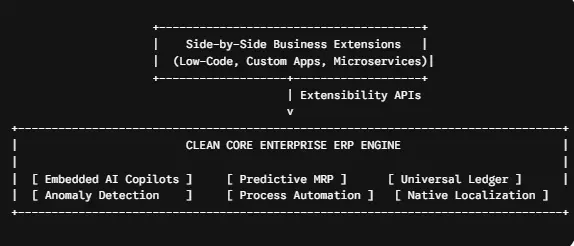
Modern Enterprise Capabilities:
- Predictive Demand Sensing: AI models continuously analyze market shifts, supplier metrics, and historical patterns to auto-tune safety stock requirements.
- Autonomous Financial Matching: Robotic process automation (RPA) and AI achieve over 95% straight-through processing rates for accounts payable and bank reconciliations.
- Clean Core Customization: Extensions and custom capabilities are decoupled via side-by-side platform capabilities and robust APIs, ensuring seamless updates without breaking custom workflows.
Defining the ERP Maturity Curve
To understand where your organization sits, evaluate your current operational environment against the enterprise maturity curve:
Reaching Level 3: Strategic Depth requires moving away from patchwork solutions and committing to a deeply integrated enterprise core system.
Key Takeaways for Executive Leadership
Selecting or upgrading an enterprise ERP platform is a business transformation strategy. When assessing solutions, enterprise CIOs and CFOs should prioritize architectural depth over superficial surface features:
- Demand Structural Scalability: Choose an architecture capable of absorbing future acquisitions and international expansions without requiring core system replacements.
- Insist on Deep Localizations: Validate that multi-country compliance and multi-currency ledgers are natively built-in, not bolted on.
- Protect the Clean Core: Leverage side-by-side extensions and standard APIs to safeguard your enterprise against upgrade technical debt.
The gold standard for enterprise ERP depth is ultimately judged by operational resilience. When complex supply chain changes occur or market regulations shift, a deep enterprise core provides the operational agility required to transform complexity into a long-term competitive advantage.
Would you like to explore a specific aspect of enterprise ERP systems, such as a tailored feature breakdown for your industry or a framework for evaluating total cost of ownership (TCO)?