
Evaluating Enterprise Resource Planning (ERP) software is one of the most consequential decisions an enterprise will ever make. A successful deployment streamlines operations across finance, human resources, supply chain, and customer relations. Conversely, a mismatched system can result in severe budget overruns, operational friction, and low user adoption.
With hundreds of platforms claiming top-tier status, how do industry analysts, enterprise architects, and software review boards consistently evaluate them? Understanding the underlying scoring models used in ERP rankings enables decision-makers to cut through marketing noise and select the platform best suited to their organization’s unique requirements.
1. Core Framework of ERP Ranking Methodologies
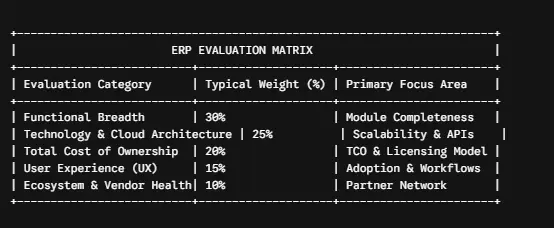
Most ERP ranking systems evaluate vendors across a comprehensive matrix. Rather than relying solely on feature checklists, modern evaluation frameworks balance technical capabilities with long-term business viability.
Major analyst firms evaluate platforms using two foundational axes:
- Completeness of Vision: Measures the vendor’s strategy, innovation pipeline, industry alignment, and geographic expansion plans.
- Ability to Execute: Evaluates the product’s current performance, customer satisfaction, pricing transparency, and financial stability.
By mapping solutions along these parameters, decision-makers can categorize platforms into distinct quadrants: Leaders, Visionaries, Challengers, and Niche Players.
2. Key Criteria in ERP Scoring Systems
To systematically rank software, scoring models aggregate dozens of metrics into five primary evaluation categories:
A. Functional Completeness and Module Breadth
An ERP system must handle complex, interconnected business processes. Evaluators assess module depth in key areas:
- Financial Management: Multi-currency handling, automated ledger reconciliation, and global tax compliance.
- Supply Chain & Manufacturing: Material Requirements Planning (MRP), inventory traceability, and demand forecasting.
- Human Capital Management (HCM): Global payroll, workforce scheduling, and talent retention tracking.
- CRM & Commerce: Omnichannel sales integration, pipeline management, and service dispatching.
B. Architecture, Scalability, and Cloud Maturity
Modern ERP evaluations heavily weight architectural design. Multi-tenant cloud architectures score higher than hosted legacy frameworks due to seamless automated updates, lower infrastructure overhead, and superior elasticity. Evaluators also test system uptime, API robustness for third-party integrations, and database performance during high-concurrency periods.
C. Total Cost of Ownership (TCO) and ROI Timelines
Top scoring systems differentiate between initial licensing fees and long-term operating costs. Evaluators scrutinize:
- Implementation Ratios: Software license fees relative to implementation partner services (typically ranging from 1:1 to 1:3).
- Licensing Transparency: User-based, consumption-based, or core-based pricing predictability over 3 to 5 years.
- Time-to-Value (TTV): How quickly an organization achieves operational payback after going live.
D. User Experience (UX) and AI Integration
System complexity directly impacts user adoption. Contemporary ranking systems award high points to intuitive, role-based dashboards, native mobile interfaces, and embedded AI automation. AI capabilities—such as automated invoice ingestion, predictive inventory routing, and natural language analytics—are now standard criteria in top rankings.
3. Comparing Tier 1, Mid-Market, and Modular Solutions
Ranking systems categorize ERP platforms based on target enterprise size and operational complexity. A system ranked highly for global enterprises may not be suitable for a mid-market distributor.
Tier 1 Enterprise ERP Systems
Designed for multi-billion-dollar conglomerates with complex, multi-entity global structures.
- Leading Platforms: SAP S/4HANA, Oracle Fusion Cloud ERP.
- Evaluation Strengths: Unmatched scalability, deep localization across hundreds of jurisdictions, and industry-specific feature sets.
- Scoring Trade-offs: Higher implementation complexity, longer deployment timelines, and substantial resource requirements.
Mid-Market Cloud Champions
Tailored for growing enterprises seeking comprehensive functionality without excessive implementation friction.
- Leading Platforms: Oracle NetSuite, Microsoft Dynamics 365 Business Central, Acumatica.
- Evaluation Strengths: Rapid deployment cycles, flexible user-based or consumption-based pricing, and native cloud scalability.
- Scoring Trade-offs: May require custom extensions for highly specialized, niche manufacturing processes.
Modular and Open-Source Platforms
Targeted at small-to-midsize businesses prioritizing affordability and customizability.
- Leading Platforms: Odoo, ERPNext.
- Evaluation Strengths: Exceptional cost efficiency, modular deployment options, and vibrant developer communities.
- Scoring Trade-offs: Variable support quality depending on implementation partners and lower native compliance depth for heavily regulated global markets.
4. How to Leverage ERP Ranking Scores for Selection
While third-party rankings offer valuable benchmarks, an off-the-shelf ranking matrix rarely reflects every organization’s specific priorities. To make an informed decision, apply a customized evaluation approach:
- Define Non-Negotiable Requirements: Identify critical functionality (e.g., lot traceability, batch management, or specific revenue recognition standards) before reviewing scores.
- Re-Weight Evaluation Criteria: Adjust standard evaluation weights to match internal goals. For example, assign higher weight to UX and mobile access if workforce adoption is a primary risk factor.
- Assess System Integrations: Verify how well potential ERP platforms connect with existing CRM, HR, or custom line-of-business applications.
- Conduct Practical Proof-of-Concept Tests: Request customized vendor demonstrations using actual operational scenarios rather than generic sales scripts.
Conclusion
ERP ranking score systems provide a structured framework for evaluating enterprise software. By assessing functional breadth, architectural maturity, TCO, and user experience, these benchmarks help organizations narrow down vendor options efficiently. However, the most effective ERP choice is ultimately determined by how closely a system’s capabilities align with an enterprise’s specific operational workflows and strategic growth plans.