
What Determines the Initial Price ERP For Company Investment?
Investing in enterprise software is one of the most critical financial decisions an executive leadership team will make. When decision-makers ask about the price ERP for company deployments, they quickly discover that there is no single fixed sticker price. The total investment required to implement a modern Enterprise Resource Planning platform varies significantly depending on business size, operational complexity, module scope, and deployment preference.
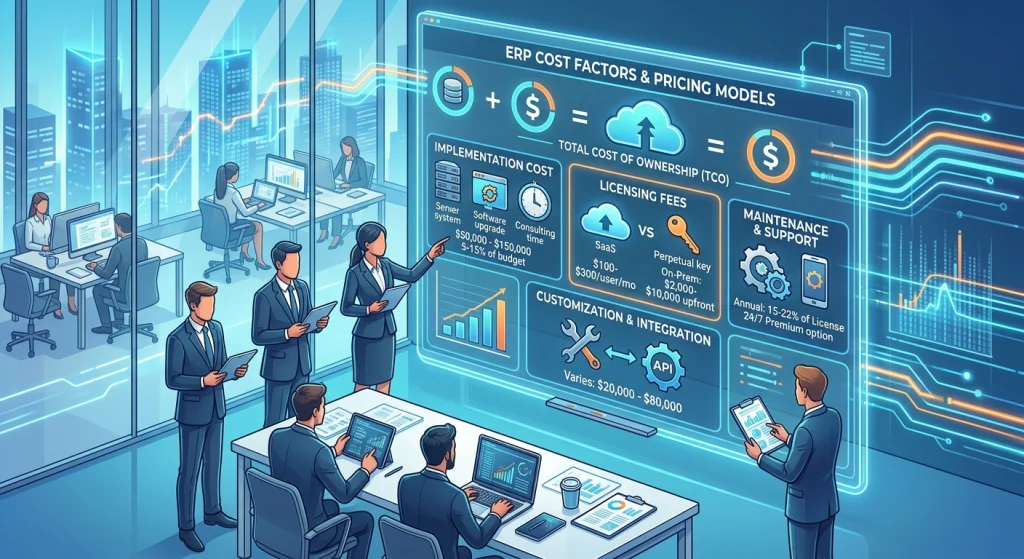
At a foundational level, an ERP system serves as the digital central nervous system of a business. It unifies accounting, supply chain, inventory, human resources, customer relations, and manufacturing workflows into a single data repository. Because every business possesses unique operational models, software vendors structure their pricing to match the specific operational scale and technical requirements of each organization.
Understanding the baseline price of an ERP system requires examining the core building blocks that compose software pricing. Small businesses might invest anywhere from twenty-five thousand dollars to one hundred fifty thousand dollars for a streamlined cloud deployment. Medium-sized market companies usually face total investment costs ranging between one hundred fifty thousand dollars and one million five hundred thousand dollars. Meanwhile, global enterprises with multi-country operations, legacy database integrations, and tens of thousands of active users often invest several million dollars to complete a full enterprise transformation.
Primary Licensing Models Driving ERP Costs
The pricing architecture chosen by an enterprise directly shapes both immediate cash outflows and long-term operating costs. Today, software vendors offer three primary software deployment and licensing models, each with distinct capital and operational implications.
Software as a Service (SaaS) and Cloud Subscriptions
Cloud-based SaaS platforms have become the dominant choice for modern corporate IT deployments. Under this subscription model, companies pay a recurring monthly or annual fee based on active user counts or resource consumption.
Per-user subscription costs generally range from fifty dollars to four hundred dollars per user each month, depending on whether the user requires basic data entry rights or advanced administrative privileges. Platforms such as Microsoft Dynamics 365, Oracle NetSuite, and SAP S/4HANA Cloud utilize this model. The cloud model drastically reduces initial capital expenditures because physical server hardware, server cooling, database maintenance, and security patching are fully managed by the cloud vendor.
On-Premises Perpetual Licensing
The traditional on-premises model requires buying perpetual software licenses upfront. Under this pricing strategy, companies pay a substantial lump-sum software license fee up front, followed by annual maintenance and support fees that typically equal eighteen to twenty-two percent of the original license cost.
Perpetual licensing demands significant capital investment in hardware infrastructure, physical server rooms, network security firewalls, and dedicated in-house IT engineering teams. While ongoing software subscription fees are eliminated after the initial purchase, the long-term cost of replacing physical hardware every five to seven years makes this option significantly more expensive over time.
Consumption and Module-Based Pricing
A growing number of modern software providers have introduced alternative pricing strategies to accommodate scaling organizations. Instead of charging strictly per named user, these providers price their software based on database transaction volume, data storage consumption, or specific operational modules activated.
This model allows growing companies to grant system access to all employees without paying additional per-user licensing penalties. Organizations only pay more as their operational volume, invoice processing, or server bandwidth requirements expand over time.
Core Components of an ERP Implementation Budget
The initial software license or cloud subscription represents only a fraction of the total expenditure. In fact, industry benchmarks indicate that professional implementation services often cost one to three times the annual software licensing fee. To build a realistic budget, company financial officers must evaluate several critical cost categories.
Implementation and System Configuration Services
Software implementation fees represent the single largest expenditure category in an ERP project. Vendors or certified system integration partners assign specialized business analysts, solution architects, and technical engineers to configure software modules around unique business workflows.
Consulting fees for integration partners typically range between one hundred fifteen dollars and two hundred fifty dollars per hour. For a mid-market enterprise, consulting and configuration services alone usually amount to between one hundred thousand dollars and six hundred thousand dollars.
Data Migration and Data Cleansing
Transitioning operational history, vendor files, customer accounts, and financial balance sheets from legacy accounting tools into a new ERP database is a delicate process. Data migration accounts for approximately five to fifteen percent of the overall implementation budget.
Legacy databases are frequently plagued by duplicated client records, inconsistent formatting, and obsolete inventory logs. Cleaning, validating, standardizing, and mapping data before transferring it to the new platform prevents system errors. Skipping proper data cleanup prior to launch is a primary reason ERP projects encounter expensive budget overruns.
Customization vs. Standardization
Every company maintains unique operational processes, but excessively customizing software code drastically inflates project costs. Software vendors design standard software out of the box around industry best practices.
When an organization insists on writing custom code to match outdated internal habits, implementation costs surge rapidly. Custom code requires continuous testing, increases system vulnerability, and can break whenever the software vendor issues standard core updates. Choosing to adapt internal processes to fit standard software capabilities remains one of the most effective ways to keep implementation costs manageable.
Third-Party Software Integrations
Rarely does an ERP system operate in complete isolation. Companies rely on specialized third-party software applications for e-commerce processing, customer relationship management, warehouse automation, shipping logistics, and payroll processing.
Connecting these external systems to the new ERP database requires building application programming interfaces (APIs) or middleware connections. Simple API connections cost several thousand dollars each, whereas complex, bi-directional data synchronizations can add fifty thousand to one hundred fifty thousand dollars to the overall project budget.
Essential Hidden Costs Companies Frequently Overlook
When calculating the total price ERP for company initiatives, project managers often focus exclusively on vendor quotes and overlook hidden indirect costs. These hidden expenses frequently lead to surprise budget adjustments during deployment.
User Training and Change Management
Employee adoption is the true metric of ERP success. Even the most advanced software platform will fail to deliver ROI if staff members struggle to navigate new workflows or revert to offline spreadsheets out of frustration.
Comprehensive change management programs, end-user training sessions, role-specific documentation, and interactive learning tools account for five to ten percent of total project costs. Budgeting five hundred to two thousand dollars per employee for specialized training ensures smooth adoption and minimizes operational friction after launch.
Internal Staff Time and Productivity Losses
Implementing an enterprise platform requires substantial time commitments from top internal performers. Subject matter experts across finance, procurement, sales, and manufacturing must dedicate hours each week to process mapping, solution testing, user acceptance validation, and training.
While these internal resource costs do not appear on external vendor invoices, they represent real operational costs. Companies often need to hire temporary staff or pay overtime to prevent everyday business operations from suffering while core employees participate in implementation workshops.
Ongoing System Maintenance and Admin Support
After the initial system launch, ongoing support costs continue throughout the software lifecycle. Cloud subscriptions include basic technical support, but enterprises usually require premium vendor support plans or internal dedicated administrators to maintain user roles, build custom reports, and optimize workflows.
Companies should allocate ten to fifteen percent of their annual software budget for post-go-live optimization, additional module rollouts, and ongoing technical support services.
Strategies to Control ERP Deployment Costs and Maximize ROI
Managing the price ERP for company projects requires disciplined governance, strategic vendor negotiations, and clear project scope management. Executive teams can implement several practical strategies to keep costs under control:
- Embrace Standard Industry Workflows: Minimize custom code requests by adopting the pre-configured industry workflows built into modern cloud platforms.
- Conduct Thorough Pre-Implementation Audits: Cleanse legacy databases and document operational requirements thoroughly before inviting software vendors to quote.
- Negotiate Multi-Year Cloud Contracts: Secure discounted user licensing rates by committing to multi-year subscription agreements with vendors.
- Adopt a Phased Rollout Strategy: Instead of attempting a high-risk “big bang” global release, deploy core financial modules first, followed by supply chain and advanced analytics modules in subsequent phases.
- Establish Clear Project Scope Boundaries: Form an internal steering committee to rigorously evaluate and approve any proposed changes to software requirements after the contract is signed.
Final Verdict: Is the Investment Worth the Price?
Determining the right price ERP for company operations requires shifting the internal discussion from short-term cost to long-term value creation. While a modern ERP system represents a substantial financial commitment, the return on investment manifests in faster financial closing cycles, reduced inventory holding costs, automated customer order fulfillment, and eliminate data silos.
By accurately projecting licensing options, implementation services, data migration requirements, and change management expenses, companies can execute a seamless software transformation that stays within budget while positioning the enterprise for sustainable competitive growth.