
What’s About ERP? Understanding the Core Concept and Operational Workflow
When business leaders ask, “What’s about ERP?”, they are inquiring about the central digital engine that powers modern corporate infrastructure. Enterprise Resource Planning refers to a unified category of business management software designed to consolidate, automate, and streamline organizational workflows across various functional departments. Instead of allowing finance, human resources, supply chain, procurement, and customer sales to operate in isolated data silos, a comprehensive system links every operational branch to a single, centralized database.
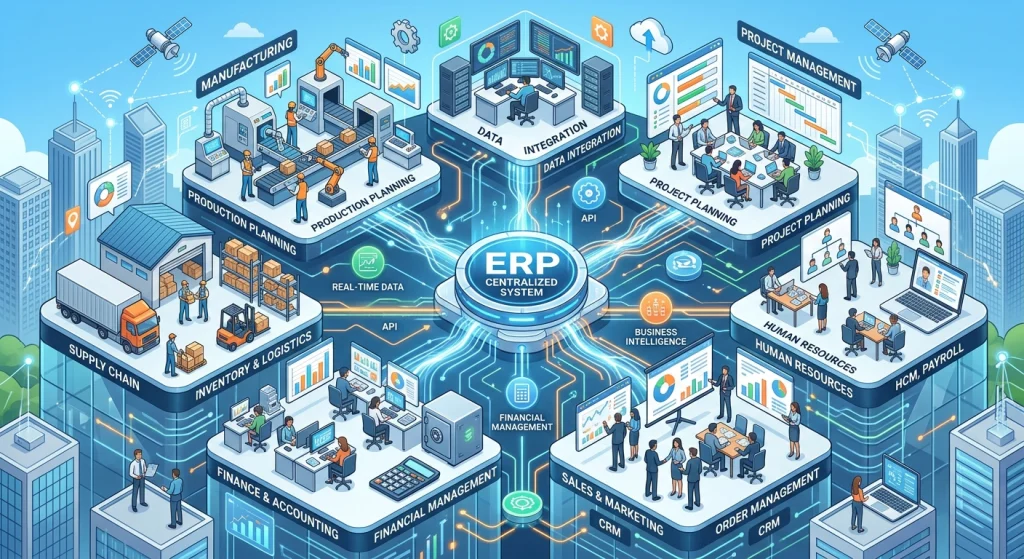
To understand how information flows through a centralized platform, consider the sequential journey of a standard business order:
- Customer Order Placement: A client submits a purchase request through an e-commerce portal or direct sales representative, instantly recording the sales entry in the database.
- Automated Inventory Verification: The system automatically checks real-time warehouse stock levels to confirm product availability and allocate inventory.
- Production and Procurement Triggering: If stock falls below set reorder thresholds, the platform automatically generates purchase orders for raw materials and creates shop-floor manufacturing tasks.
- Financial Ledger Updating: As the warehouse fulfills and ships the order, the system updates financial ledgers, creates accounts receivable entries, and generates customer invoices without manual data entry.
- Real-Time Executive Analytics: Operational data instantly reflects on executive dashboards, providing leadership with live insights into revenue, inventory turnover, and supply chain efficiency.
The Historical Evolution of Enterprise Resource Planning
Understanding the context behind What’s about ERP? requires looking back at how enterprise management technology evolved over recent decades.
Material Requirements Planning (MRP) in the 1960s
The initial foundation of operational enterprise software began in the manufacturing sector. Material Requirements Planning platforms focused primarily on calculating material quantities, scheduling production runs, and managing basic inventory levels on mainframe computers.
MRP II and Advanced Manufacturing Control in the 1980s
As computer hardware capability improved, software platforms expanded to include shop-floor scheduling, machine capacity planning, and basic financial accounting integrations. This shift laid the framework for modern cross-departmental coordination.
The Birth of Modern ERP Systems in the 1990s
By the early 1990s, software architects unified back-office functions—such as human resources, deep financial accounting, procurement, and asset management—into comprehensive enterprise platforms, giving birth to integrated enterprise resource planning solutions.
The Transition to Cloud-Native Ecosystems
Today, modern platforms have abandoned traditional on-premises server environments in favor of elastic, cloud-native architectures. Equipped with embedded artificial intelligence, Internet of Things (IoT) integrations, and predictive analytics, modern enterprise platforms operate continuously with real-time accessibility from any location.
Key Functional Modules Powering Enterprise Resource Planning
A primary reason businesses evaluate What’s about ERP? is to understand its modular adaptability. Enterprise platforms consist of interconnected modules designed to handle specific operational domains while sharing a common database core.
Financial Management and Accounting Module
The financial engine serves as the foundational core of enterprise software. It centralizes accounts payable, accounts receivable, general ledger tracking, fixed asset accounting, tax compliance, and multi-currency conversions. Automating financial ledger updates accelerates month-end closing cycles and ensures audit readiness.
Supply Chain and Logistics Module
Managing global supply chain networks requires strict operational visibility. This module tracks procurement, vendor relationships, material management, warehouse fulfillment, and shipping logistics. Built-in demand forecasting algorithms prevent stockouts and minimize inventory holding costs.
Human Capital Management (HCM) Module
Workforce management requires tracking diverse data points. The HCM module automates payroll calculation, employee onboarding, benefits administration, time and attendance tracking, performance management, and organizational hierarchy planning.
Customer Relationship Management (CRM) Module
Connecting customer-facing operations with back-office supply chain networks improves service delivery. The CRM module records sales pipelines, customer communication histories, service tickets, and contract terms, giving account managers complete operational transparency.
Manufacturing and Quality Control Module
Designed specifically for production environments, this module coordinates master production schedules, bill of materials (BOM) management, shop-floor dispatching, quality assurance inspections, and equipment maintenance schedules.
Strategic Advantages of Deploying Enterprise Resource Planning
Evaluating What’s about ERP? from a return-on-investment perspective highlights several transformative operational benefits that drive long-term business growth.
1. Total Operational Visibility and Real-Time Insights
Relying on manual, disconnected spreadsheets leads to reporting errors and delayed strategic decisions. Centralized enterprise platforms deliver interactive dashboards powered by live data, allowing executive leadership to evaluate profit margins, cash flow, and operational efficiency instantly.
2. Elimination of Redundant Workflows and Data Entry
Manual data transfer between standalone software applications creates administrative bottlenecks and risks data duplication errors. Centralized platforms automate repetitive administrative workflows, such as invoicing, inventory updates, and order confirmations, freeing personnel to focus on high-value strategic tasks.
3. Enhanced Regulatory Compliance and Audit Controls
Operating in global markets requires strict adherence to evolving accounting standards, environmental regulations, and privacy frameworks. Enterprise software maintains immutable digital audit trails for every database modification, simplifying external financial audits and safeguarding data integrity under frameworks like GDPR, HIPAA, or SOX.
4. Seamless Scalability for Corporate Expansion
As organizations expand into international markets, launch new lines of business, or acquire subsidiaries, flexible cloud architecture scales effortlessly. Multi-tenant cloud systems accommodate growing user numbers, localized tax rules, and complex organizational structures without needing complete infrastructure overhauls.
Cloud-Native vs. On-Premises Architecture
When investigating What’s about ERP?, understanding the architectural options available for deployment is critical to making an informed software investment.
On-Premises Deployment Model
On-premises deployments host software applications directly on physical servers situated within an organization’s own data center facility. This configuration requires substantial upfront capital expenditure for server hardware, networking infrastructure, database licenses, and ongoing facility maintenance. Furthermore, internal IT teams remain entirely responsible for manual system updates, security patches, hardware repairs, and disaster recovery planning. While on-premises setups provide absolute local control over database storage, they lack elasticity and are expensive to maintain long-term.
Cloud-Native SaaS Deployment Model
Cloud-native solutions operate on subscription-based operating expense models hosted on distributed cloud environments like Amazon Web Services, Microsoft Azure, or Google Cloud. Software vendors handle all underlying infrastructure, system upgrades, security patches, and database backups automatically. Cloud platforms eliminate physical server maintenance costs, deliver continuous software updates quarterly, and allow employees to access system tools securely from any device or geographical location.
Hybrid ERP Environment
A hybrid deployment combines on-premises servers with cloud-hosted applications. Many manufacturing enterprises utilize hybrid setups by keeping specialized shop-floor control systems on local physical servers for immediate low-latency processing, while running financial management, HR, and sales operations in the cloud.
Best Practices for a Successful Implementation
Implementing enterprise software is a comprehensive operational transformation that requires careful planning, executive governance, and disciplined change management.
Step 1: Define Clear Strategic Objectives and Scope
Identify specific operational friction points, such as high inventory carrying costs, slow financial closing times, or fragmented customer data. Establish clear key performance indicators (KPIs) to measure project success before selecting software options.
Step 2: Establish Cross-Functional Steering Leadership
Form a dedicated project steering committee that includes executive sponsors, departmental leaders, technical architects, and experienced implementation partners. Executive alignment ensures project milestones stay on schedule and within budget parameters.
Step 3: Prioritize Data Cleansing and Governance
Migrating dirty, obsolete, or duplicated data into a clean new environment leads to post-launch system errors and user frustration. Establish strict data governance standards to cleanse, standardize, and validate all legacy master records prior to system migration.
Step 4: Execute Structured User Training and Change Management
System adoption determines ultimate project success. Develop role-based training initiatives, document standardized operating procedures clearly, and designate internal change champions within each functional team to help colleagues adapt to new workflows.
Step 5: Conduct Comprehensive System Integration Testing
Before scheduling go-live cutovers, conduct rigorous testing cycles, including unit testing, API integration verification, end-to-end operational simulations, and user acceptance testing (UAT) to confirm data accuracy and system stability.
Conclusion: Future-Proofing Your Business Operations
So, What’s about ERP? Ultimately, enterprise resource planning is the foundational technological framework that enables modern businesses to operate with speed, transparency, and strategic precision. By unifying disconnected business functions into a single cloud-native digital ecosystem, enterprises eliminate operational inefficiencies, strengthen data security, and position themselves for sustained market leadership.
Whether transitioning from outdated legacy software or upgrading from basic spreadsheet management, investing in a modern, scalable enterprise platform builds a resilient operational foundation for long-term growth and digital innovation.