
What Are Systems ERP and How Do They Work?
In today’s fast-paced corporate environment, managing complex operations across multiple departments requires seamless coordination and centralized data. Enterprise Resource Planning platforms, widely recognized as systems ERP, serve as the technological backbone for modern organizations. These integrated software environments bring together key operational functions—such as financial management, human resources, supply chain operations, inventory tracking, and customer management—into a single unified database.
The fundamental purpose of systems ERP is to eliminate operational silos. Instead of individual departments maintaining disconnected software tools, spreadsheets, or independent databases, every team accesses and updates information within a shared architecture. When a sales representative creates a customer order, the system automatically updates real-time inventory levels, notifies the fulfillment team, triggers supply chain reordering thresholds, and records the financial transaction in the general ledger. This automated synchronization ensures data integrity, minimizes human error, and gives executive leadership a clear, real-time view of organizational performance.
Historically, enterprise software was heavily fragmented, forcing organizations to build fragile custom integrations between financial tools and warehouse management programs. Modern ERP architecture solves this issue by offering modular designs. Companies can deploy essential core applications first and gradually integrate specialized modules as business operational complexity grows over time.
Core Components and Modules of Systems ERP
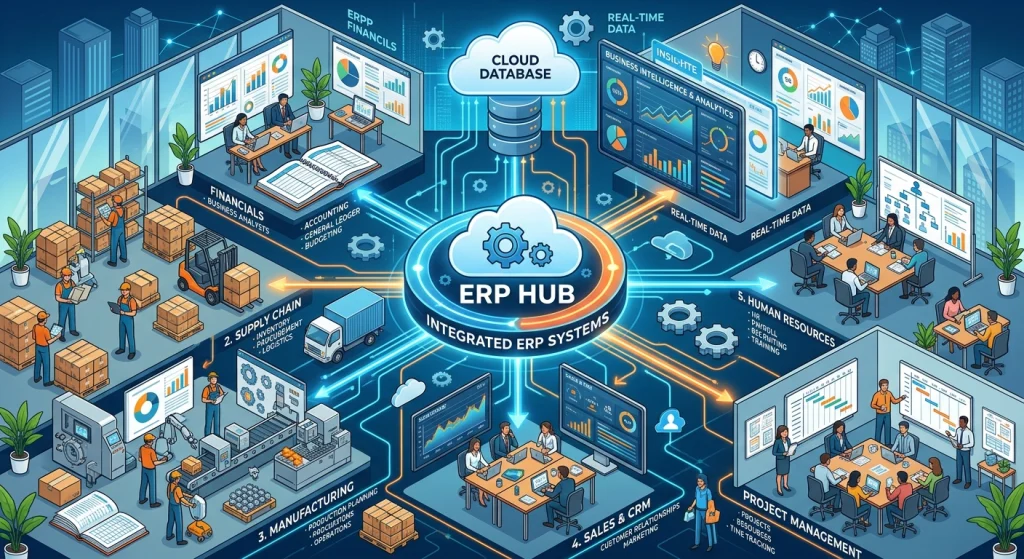
To understand the full scope of enterprise resource planning, it is helpful to examine the essential modules that make up comprehensive systems ERP. While implementation configurations vary depending on industry requirements, most enterprise solutions rely on several core functional building blocks.
Financial Management and Accounting Module
The financial module serves as the primary core of most enterprise systems. It automates financial ledger management, accounts payable, accounts receivable, budgeting, fixed asset management, and tax compliance. By centralizing financial data, business leaders can execute automated month-end financial closes, audit transaction histories, and generate precise balance sheets in real time.
Supply Chain and Inventory Management Module
For manufacturing, wholesale, and retail organizations, supply chain control is vital. This module provides end-to-end visibility across procurement, warehouse management, material management, order fulfillment, and logistics planning. Advanced algorithms monitor inventory levels, predict supply disruptions, and optimize stock replenishment to minimize carrying costs and operational delays.
Human Capital Management (HCM) Module
Managing workforce operations efficiently requires robust tools. The HCM module automates employee onboarding, time and attendance tracking, payroll processing, benefits administration, performance management, and organizational hierarchy planning. Centralizing human resources management simplifies workforce scheduling and maintains compliance with local labor regulations.
Customer Relationship Management (CRM) Module
Integrating sales and customer service operations into core software ensures smooth communication from lead generation to order delivery. The CRM component tracks sales pipelines, customer interaction logs, service ticket history, and contract management details, providing customer success teams with complete operational context.
Manufacturing and Production Planning Module
For production environments, this module controls bill of materials (BOM), shop floor scheduling, capacity planning, quality control, and work-order management. Real-time shop floor visibility prevents manufacturing bottlenecks and aligns production throughput directly with customer demand forecasts.
The Transformative Benefits of Implementing Systems ERP
Transitioning to integrated enterprise software offers profound operational, strategic, and financial advantages. Organizations that successfully deploy modern platforms transform how their teams collaborate and execute daily processes.
1. Eliminating Data Silos and Enhancing Real-Time Analytics
Without integrated software, leadership teams rely on static, manually compiled spreadsheets to evaluate company performance. This creates reporting delays and inconsistent data points across departments. Advanced systems ERP provide interactive executive dashboards fed by live operational data. Decision-makers can instantly review profit margins, monitor supply chain efficiency, or track project milestones without waiting for manual weekly summaries.
2. Streamlining Operational Processes and Automation
Manual data entry across disconnected software applications creates operational bottlenecks and increases administrative overhead. Modern platforms automate repetitive tasks, such as generating customer invoices, processing purchase orders, updating stock balances, and sending delivery notifications. Automating these workflows frees up personnel to focus on higher-value strategic initiatives.
3. Improving Regulatory Compliance and Risk Management
Operating across global markets requires strict compliance with evolving financial, environmental, and industry-specific regulations. Enterprise solutions maintain detailed digital audit trails for every transaction, system change, and document modification. Built-in compliance controls simplify financial auditing and protect sensitive data under regulations such as GDPR, HIPAA, or SOX.
4. Enhancing Scalability for Long-Term Business Growth
As organizations expand into new geographic markets, acquire subsidiaries, or launch e-commerce platforms, legacy software setups struggle to adapt. High-performing software architectures are engineered to scale effortlessly. Multi-currency support, multi-language interfaces, and customizable workflows allow growing enterprises to expand without replacing their underlying IT infrastructure.
Cloud Systems ERP vs. On-Premises Systems ERP
When selecting an enterprise planning platform, organizations must evaluate deployment models carefully. The operational and financial differences between cloud-based and on-premises architectures shape how systems are maintained, updated, and scaled over their lifecycle.
On-premises platforms require physical server hardware, local database infrastructure, and dedicated on-site IT teams to handle maintenance, data backups, and manual patch deployments. This model requires significant upfront capital expenditure (CapEx) for hardware and software licensing, alongside ongoing facility expenses.
In contrast, cloud-hosted platforms operate on a subscription model (OpEx) hosted on secure cloud infrastructure provided by vendors like Amazon Web Services, Microsoft Azure, or Google Cloud. Cloud software eliminates physical server hardware costs and delivers automatic software updates without interrupting business operations. Furthermore, cloud architectures support remote workforce access, allowing employees to access systems securely from any location or mobile device.
While some highly regulated industries or legacy manufacturing organizations continue using on-premises software for direct hardware control, the enterprise technology market has shifted decisively toward cloud setups due to their elasticity, lower total cost of ownership, and continuous innovation delivery.
Key Steps for a Successful Implementation
Deploying enterprise-wide software is a major project that requires strategic alignment, clear governance, and disciplined change management. Following a structured execution roadmap minimizes operational disruption and maximizes investment returns.
Step 1: Requirements Gathering and Scope Definition
Begin by analyzing existing organizational workflows to identify operational bottlenecks and key performance gaps. Involve stakeholders from finance, operations, sales, IT, and human resources to define functional requirements, implementation milestones, and core project goals.
Step 2: Vendor Selection and Architectural Evaluation
Evaluate software solutions based on industry alignment, API integration capabilities, vendor stability, cloud security standards, and customization capabilities. Choose platforms that match your specific operational scale and offer long-term product roadmaps.
Step 3: Data Cleansing, Mapping, and Migration
Data migration is often the most critical phase of an implementation project. Legacy systems frequently hold outdated, duplicate, or unstandardized records. Cleanse, validate, and structure your master data thoroughly before migrating it to the target enterprise database to prevent functional errors after launch.
Step 4: System Configuration and Testing
Configure system modules, custom workflows, user authorization levels, and third-party API integrations according to established business requirements. Conduct rigorous testing phases, including unit testing, integration testing, and user acceptance testing (UAT), to verify data accuracy and operational stability.
Step 5: Change Management and End-User Training
System adoption relies heavily on user preparation. Develop role-based training programs, document operating procedures clearly, and designate department power-users to support staff during transition phases. Proactive change management minimizes operational disruption and builds confidence across the workforce.
Step 6: Go-Live Execution and Ongoing Optimization
Plan the go-live deployment carefully, selecting low-volume business periods or utilizing phased departmental rollouts to mitigate risk. Maintain dedicated technical support during post-launch periods to resolve user issues quickly and optimize system configuration based on operational feedback.
Conclusion: Future-Proofing Your Organization
Adopting modern systems ERP is no longer just an IT upgrade; it is a fundamental business transformation. By consolidating core operations into a centralized, real-time software ecosystem, enterprises eliminate structural inefficiencies, protect against security threats, and equip their teams with actionable intelligence.
Whether upgrading from legacy infrastructure or moving away from fragmented spreadsheet management, investing in a scalable, cloud-native enterprise platform establishes a resilient foundation for long-term operational success, agility, and sustainable competitive growth.